11  Part 2: The Exclusion Restriction

▶ Load required packages
# install.packages(c("tidyverse","ggplot2","knitr","scales","patchwork"))

library(tidyverse)
library(ggplot2)
library(knitr)
library(scales)
library(patchwork)
if (!requireNamespace("lavaan", quietly = TRUE)) install.packages("lavaan")
library(lavaan)

set.seed(2025)

12 Part 2: The Exclusion Restriction — What Else Is in Your Treatment?

12.1 One Button, Many Signals

In Part 1 we treated the eco-label manipulation as a clean, unidimensional intervention: it either increases WTP (H₁) or it does not (H₀). This framing is convenient, but it hides a problem that is exactly analogous to what Module 1 revealed about measuring Y.

Recall the core lesson from Module 1:

A scale item labeled “Green Purchase Intention” often captures several distinct latent constructs simultaneously — environmental values, social signaling, perceived quality, price expectations, and more. The scale appears to measure one thing while actually measuring many. This is a violation of discriminant validity.

Now ask the same question about your treatment variable:

When a participant sees an eco-certification badge on a coffee package, what does that label actually do?

It does not inject a single, clean signal of “eco-friendliness.” It activates — simultaneously and heterogeneously — a cluster of inferences, associations, and motivations that vary across people. This is a violation of the exclusion restriction: the assumption that the treatment variable affects the outcome only through the intended pathway.

ImportantThe Exclusion Restriction — the single-mechanism assumption

The exclusion restriction is the assumption that X affects Y through exactly one latent pathway — the one the researcher intends. Every field has a name for what happens when this assumption breaks:

Field Term for the violation
Psychology / Marketing Confound — the manipulation activates an unintended construct alongside the intended one
Econometrics Endogeneity — the regressor correlates with the error term via unmodelled channels
Epidemiology Confounding — exposure and outcome share a common cause
Statistics Omitted variable bias — a variable that belongs in the model is left out
Causal inference (DAGs) Backdoor path — a non-causal association flows through an unmeasured variable

All of these are the same problem viewed through different disciplinary lenses: there is more than one latent link between X and Y.

If X injects additional unintended signals that also causally influence Y — and if those signals vary across participants — then the estimated “treatment effect” is a weighted mixture of several distinct causal effects, not a single clean estimate of any one of them.

This is the fundamental identification problem in causal inference, and it is the experimental analogue of discriminant invalidity in measurement. In Module 1 you saw that measured Y can measure too much. Here you will see that manipulated X can inject too much.

12.2 Simulating a Confounded Study

We now simulate the coffee experiment with a realistic data-generating process that captures how the exclusion restriction fails in practice.

The researcher intends the eco-label to be the only thing that differs between conditions. But in preparing the stimuli, the two versions of the coffee bag were not held perfectly equal: the eco-label condition also happened to use a more premium-looking package design — darker color scheme, cleaner typography, higher perceived quality cues. Participants in the eco-label condition therefore receive a bundle: eco-certification plus a premium visual presentation. Both signals independently increase WTP through different pathways.

This is the exclusion restriction failure in concrete form: the treatment variable injects two distinct latent signals, not one. Any estimated “eco-label effect” is a conflation of the two.

▶ Simulate 120 participants with confounded eco-label and premium design
set.seed(2026)
N_p2  <- 120
half2 <- N_p2 / 2

# ── Participant-level binary traits ───────────────────────────────────────────
ptrait <- function(p) rbinom(N_p2, 1, p)

traits <- data.frame(
  env_values      = ptrait(0.45),  # cares about environment
  quality_seek    = ptrait(0.50),  # focuses on quality / taste
  price_sensitive = ptrait(0.50),  # price-conscious
  social_identity = ptrait(0.40),  # identity / values-driven purchasing
  health_focus    = ptrait(0.45),  # health / natural-ingredient preference
  brand_trust     = ptrait(0.55),  # responds to certification cues
  guilt_prone     = ptrait(0.35),  # guilt-reducing / compensatory consumption
  hedonic         = ptrait(0.50),  # pleasure-driven; taste is paramount
  habitual        = ptrait(0.40),  # habitual buyer; resists stretching budget
  demand_aware    = ptrait(0.40)   # susceptible to experimenter demand / social desirability cues
)

# ── Equal random assignment ───────────────────────────────────────────────────
condition_p2 <- rep(c("Control", "Eco-label"), each = half2)
eco          <- as.integer(condition_p2 == "Eco-label")

# ── The confound: premium design is perfectly tied to the eco-label condition ─
# In a real study this could be a subtly different image, font, or color scheme
# that slipped through stimuli review. It is unobserved by the researcher.
premium_design <- eco  # r = 1.0 with treatment — impossible to separate without measuring

# ── WTP simulation (in dollars, clamped to $1–$10) ────────────────────────────
# True causal structure:
#   Path A (eco-certification): activates eco-responsive traits → conditional premium
#   Path B (premium design):    boosts perceived quality for EVERYONE → unconditional lift
#   Both paths are real effects; the researcher cannot separate them from the t-test alone.
WTP_p2 <- with(traits, {
  # Path A — eco-certification effect (heterogeneous: depends on eco-responsive traits)
  eco_effect <-
    1.00 * env_values      * eco  +  # env concern → eco premium
    0.65 * quality_seek    * eco  +  # quality-seekers respond to certification
    0.80 * social_identity * eco  +  # identity-driven eco premium
    0.50 * health_focus    * eco  +  # health focus eco premium
    0.45 * brand_trust     * eco  +  # certification trust premium
    0.30 * guilt_prone     * eco  +  # guilt-offset premium
    0.50 * demand_aware    * eco     # demand effects in eco context

  # Path B — premium design effect (homogeneous: affects everyone in eco condition)
  design_effect <- 0.70 * premium_design  # unconditional quality-perception lift

  # Baseline WTP (trait-driven, condition-independent)
  base <-
    4.50 +
    0.30 * quality_seek    +  # quality-seekers have higher baseline WTP
   -0.70 * price_sensitive +  # price sensitivity suppresses WTP
    0.30 * hedonic         +  # hedonic adds WTP in both
   -0.45 * habitual           # habitual buyers resist stretching

  v <- base + eco_effect + design_effect + rnorm(N_p2, 0, 0.75)
  pmax(pmin(round(v, 2), 10), 1)
})

df_p2 <- data.frame(traits, condition = condition_p2,
                    premium_design = premium_design, WTP = WTP_p2)

# ── What the researcher sees: a clean-looking treatment effect ────────────────
df_p2 |>
  group_by(condition) |>
  summarise(n = n(), mean_WTP = round(mean(WTP), 2),
            sd_WTP = round(sd(WTP), 2), .groups = "drop") |>
  kable(col.names = c("Condition", "n", "Mean WTP", "SD WTP"),
        align   = c("l", "c", "c", "c"),
        caption = "WTP summary by condition — what the researcher observes")
WTP summary by condition — what the researcher observes
Condition n Mean WTP SD WTP
Control 60 4.07 0.73
Eco-label 60 6.72 1.25

The summary table shows a clean, positive treatment effect. The researcher would likely report this as evidence that eco-certification raises WTP. But the figure below shows what is actually happening:

▶ Plot: decompose observed effect into eco-certification vs. premium design paths
# Reconstruct each path's contribution at the participant level
df_p2 <- df_p2 |>
  mutate(
    eco_int = as.integer(condition == "Eco-label"),
    # Path A: eco-responsive traits × eco condition
    path_A = (1.00 * env_values + 0.65 * quality_seek + 0.80 * social_identity +
              0.50 * health_focus + 0.45 * brand_trust + 0.30 * guilt_prone +
              0.50 * demand_aware) * eco_int,
    # Path B: premium design (everyone in eco condition gets +0.70)
    path_B = 0.70 * premium_design,
    # Eco-responsive trait count for x-axis ordering
    n_eco_traits = env_values + quality_seek + social_identity +
                   health_focus + brand_trust + guilt_prone
  )

# Group-level averages for the annotation
avg_A <- round(mean(df_p2$path_A[df_p2$condition == "Eco-label"]), 2)
avg_B <- round(mean(df_p2$path_B[df_p2$condition == "Eco-label"]), 2)
naive <- round(mean(df_p2$WTP[df_p2$condition == "Eco-label"]) -
               mean(df_p2$WTP[df_p2$condition == "Control"]), 2)

path_long <- df_p2 |>
  filter(condition == "Eco-label") |>
  select(n_eco_traits, path_A, path_B) |>
  pivot_longer(c(path_A, path_B),
               names_to = "pathway",
               values_to = "contribution") |>
  mutate(pathway = recode(pathway,
    "path_A" = "Path A: Eco-certification\n(heterogeneous — depends on traits)",
    "path_B" = "Path B: Premium design\n(homogeneous — same for everyone)"))

ggplot(path_long, aes(x = n_eco_traits, y = contribution, color = pathway)) +
  geom_jitter(width = 0.2, alpha = 0.55, size = 2.5) +
  geom_smooth(method = "loess", se = FALSE, linewidth = 1.4, span = 0.9) +
  annotate("label", x = 5.8, y = 2.8,
           label = sprintf("Observed \u0394WTP = $%.2f\n  Path A (eco) = $%.2f avg\n  Path B (design) = $%.2f avg",
                           naive, avg_A, avg_B),
           size = 3.2, hjust = 1, fill = "#fff8e1", label.size = 0.3) +
  scale_color_manual(values = c("Path A: Eco-certification\n(heterogeneous — depends on traits)" = "#2d6a4f",
                                "Path B: Premium design\n(homogeneous — same for everyone)"     = "#e07b39"),
                     name = NULL) +
  scale_y_continuous(labels = function(x) paste0("$", x)) +
  scale_x_continuous(breaks = 0:6) +
  labs(x = "Number of eco-responsive traits (participant characteristic)",
       y = "WTP contribution ($)",
       title = "The Observed Treatment Effect Bundles Two Distinct Causal Paths",
       subtitle = "Path A varies by participant; Path B is constant — both are invisible to the researcher") +
  theme_minimal(base_size = 12) +
  theme(legend.position = "top", panel.grid.minor = element_blank(),
        legend.text = element_text(size = 9))

The plot shows what a researcher cannot see from the t-test alone. Path A — the true eco-certification effect — varies by participant: participants with many eco-responsive traits gain more from the label, while those with few traits gain little. Path B — the premium design effect — is a flat $0.7 lift for everyone in the eco-label condition, regardless of any trait.

When the researcher reports the overall WTP difference of $2.65, they attribute the entire effect to eco-certification. But roughly $0.7 of that is driven by the premium package design — a confound that was never randomized away because it was never measured. The true average eco-label effect across participants is only $1.88, not $2.65.

The exclusion restriction failed: the manipulation injected two latent signals into a single condition dummy, and the treatment coefficient absorbs both.

12.3 What Participants Say: Template-Based Open-Ended Responses

To make the multi-signal nature of the treatment visible, we generate short open-ended responses from each simulated participant. These represent (a) what they infer about the product and (b) why they chose their WTP. We use template-based generation — each participant’s active traits and condition determine which phrases they contribute.

Note: We are using template-based text here to keep everything reproducible without an LLM API. In a real study you would collect actual open-ended responses. The patterns illustrated below — differential concept activation by condition, and concept–WTP correlations — would be recovered from those real responses using the same analysis pipeline.

▶ Generate template-based open-ended text for each participant
set.seed(2026)

# ── Product perception text ───────────────────────────────────────────────────
gen_product_text <- function(i) {
  cond <- condition_p2[i]
  ev   <- traits$env_values[i]
  qs   <- traits$quality_seek[i]
  ps   <- traits$price_sensitive[i]
  si   <- traits$social_identity[i]
  hf   <- traits$health_focus[i]
  bt   <- traits$brand_trust[i]
  gp   <- traits$guilt_prone[i]
  hed  <- traits$hedonic[i]
  da   <- traits$demand_aware[i]

  parts <- character(0)

  if (cond == "Control") {
    parts <- c(parts, sample(c(
      "This looks like a standard coffee blend.",
      "A fairly typical coffee package — nothing unusual.",
      "The packaging is clean and straightforward."
    ), 1))
    if (qs  == 1) parts <- c(parts, "The blend seems like decent, everyday quality.")
    if (ps  == 1) parts <- c(parts, "The price point appears reasonable and fair.")
    if (bt  == 1) parts <- c(parts, "The packaging gives a professional, trustworthy impression.")
    if (hed == 1) parts <- c(parts, "I am curious how the flavor compares to my usual brand.")
    if (length(parts) == 1)
      parts <- c(parts, "Nothing in particular stands out about this product.")
  } else {
    parts <- c(parts, "The eco-certification badge is immediately noticeable.")
    if (ev == 1) parts <- c(parts, "The sustainability label signals that this coffee is responsibly and environmentally sourced.")
    if (qs == 1) parts <- c(parts, "Eco-certified products suggest a higher standard of care in production, which I associate with better quality and taste.")
    if (ps == 1) parts <- c(parts, "Certifications usually carry a price premium, so I expect this to cost more than a standard option.")
    if (si == 1) parts <- c(parts, "This brand's values align with mine — I actively look for and support products like this.")
    if (hf == 1) parts <- c(parts, "Eco-certified means fewer pesticides and more natural farming practices, which I find very appealing.")
    if (bt == 1) parts <- c(parts, "A third-party certification badge means independent accountability — that increases my trust in the product significantly.")
    if (gp == 1) parts <- c(parts, "Buying a certified sustainable product lets me offset some of my everyday environmental footprint.")
    if (da == 1) parts <- c(parts, "The research context makes it clear this study is about eco-labeling, which makes me more conscious of how much I should value green products.")
    if (length(parts) == 1)
      parts <- c(parts, "The label catches my eye, though I am not sure how much weight I give eco-certifications in practice.")
  }

  paste(sample(parts, min(2L, length(parts))), collapse = " ")
}

# ── WTP justification text ────────────────────────────────────────────────────
gen_wtp_text <- function(i) {
  cond <- condition_p2[i]
  ev   <- traits$env_values[i]
  qs   <- traits$quality_seek[i]
  ps   <- traits$price_sensitive[i]
  si   <- traits$social_identity[i]
  hf   <- traits$health_focus[i]
  hed  <- traits$hedonic[i]
  hab  <- traits$habitual[i]
  da   <- traits$demand_aware[i]

  parts <- character(0)

  if (hab == 1 & ps == 1)
    parts <- c(parts, "I am fairly budget-conscious about coffee and set my limit based on what I can realistically afford each week.")
  if (qs == 1)
    parts <- c(parts, "I am willing to pay more when I believe the quality genuinely delivers on taste and enjoyment.")
  if (ev == 1 & cond == "Eco-label")
    parts <- c(parts, "I factored in the environmental benefits — supporting sustainable production is worth a modest premium to me.")
  if (si == 1 & cond == "Eco-label")
    parts <- c(parts, "I would pay more for a product that represents my values, even if cheaper alternatives are available.")
  if (hf == 1 & cond == "Eco-label")
    parts <- c(parts, "Cleaner and more natural sourcing justifies a higher price — I think of it as an investment in my health.")
  if (ps == 1)
    parts <- c(parts, "Price matters a great deal to me — I try not to overpay regardless of how appealing the product looks.")
  if (hab == 1)
    parts <- c(parts, "My spending on coffee tends to stay fairly consistent — habit guides my budget more than any single product feature.")
  if (hed == 1)
    parts <- c(parts, "If I expect genuinely exceptional taste, I am happy to stretch my usual budget.")
  if (da == 1 & cond == "Eco-label")
    parts <- c(parts, "Being in a study about eco products made me want to demonstrate my environmental awareness, which may have inflated my stated price slightly.")
  if (length(parts) == 0)
    parts <- "I set my price based on the overall value I expect — quality relative to cost."

  paste(sample(parts, min(2L, length(parts))), collapse = " ")
}

# Generate product text first so we can use WTP amounts in WTP text generation
product_text <- sapply(seq_len(N_p2), gen_product_text)

# Add a WTP-amount-anchored phrase to the WTP text to ensure the open-ended
# responses actually correlate with stated WTP (as real responses would).
# Four tiers ensure continuous WTP correlates well with text-derived concept scores.
# High WTP → quality/trust/sustainability language.
# Mid-high WTP → moderate value framing.
# Mid-low WTP → neutral / cost-aware framing.
# Low WTP → price/budget/overpay language (matches price_cost concept negatively).
add_wtp_anchor <- function(i, base_text) {
  w <- WTP_p2[i]
  anchor <- if (w >= 7.5) {
    "Summing it up: the quality, trustworthiness, and sustainability of this product make it genuinely worth a significant premium — I would pay well above my usual coffee budget for it."
  } else if (w >= 6.0) {
    "Summing it up: I see real quality and value here — a moderate premium feels fully justified, and I am comfortable stretching a bit beyond my typical spend."
  } else if (w >= 4.5) {
    "Summing it up: the value seems fair but nothing exceptional — I would not pay much of a premium over what a comparable standard product costs."
  } else {
    "Summing it up: I am quite price-sensitive and budget-conscious about coffee — I would not want to overpay, and my price ceiling here is close to what I normally spend."
  }
  paste(base_text, anchor)
}

wtp_text_raw <- sapply(seq_len(N_p2), gen_wtp_text)
wtp_text     <- mapply(add_wtp_anchor, seq_len(N_p2), wtp_text_raw)

# Preview a few responses
preview <- data.frame(
  Condition        = condition_p2[c(1, half2 + 1)],
  `Product text`   = product_text[c(1, half2 + 1)],
  `WTP text`       = wtp_text[c(1, half2 + 1)],
  check.names = FALSE
)
kable(preview, caption = "Example responses (one control, one eco-label participant)")
Example responses (one control, one eco-label participant)
Condition Product text WTP text
Control This looks like a standard coffee blend. I am curious how the flavor compares to my usual brand. My spending on coffee tends to stay fairly consistent — habit guides my budget more than any single product feature. Price matters a great deal to me — I try not to overpay regardless of how appealing the product looks. Summing it up: I am quite price-sensitive and budget-conscious about coffee — I would not want to overpay, and my price ceiling here is close to what I normally spend.
Eco-label Eco-certified means fewer pesticides and more natural farming practices, which I find very appealing. The research context makes it clear this study is about eco-labeling, which makes me more conscious of how much I should value green products. If I expect genuinely exceptional taste, I am happy to stretch my usual budget. Cleaner and more natural sourcing justifies a higher price — I think of it as an investment in my health. Summing it up: the value seems fair but nothing exceptional — I would not pay much of a premium over what a comparable standard product costs.

12.4 Text Analysis: How Concept Composition Shifts Across Conditions

We now run a simple concept-count analysis — no API, no black-box model. Each concept is defined by a set of keywords; a participant “mentions” a concept if any keyword appears in their text.

▶ Count concept mentions and compare across conditions
# ── Concept dictionary (regex patterns) ──────────────────────────────────────
concept_dict <- c(
  sustainability  = "sustainab|eco.certif|environmental|responsib",
  quality_taste   = "quality|taste|flavor|blend",
  price_cost      = "price|premium|afford|budget|overpay",
  social_values   = "values|align|represent|support products",
  health_natural  = "health|natural|pesticide|farming|cleaner",
  trust_cert      = "certif|accountab|trustworth",
  guilt_offset    = "footprint|guilt|offset",
  demand_effect   = "research context|study.*eco|should value|demonstrate.*environ|inflated.*stated|awareness.*study",
  hedonic         = "exceptional|happy to stretch|enjoyment",
  habit_routine   = "habit|consistent|weekly"
)

# Concept presence (1/0) per participant
prod_conc <- as.data.frame(
  lapply(concept_dict, function(pat) as.integer(grepl(pat, tolower(product_text)))))

wtp_conc <- as.data.frame(
  lapply(concept_dict, function(pat) as.integer(grepl(pat, tolower(wtp_text)))))

prod_conc$condition <- condition_p2
wtp_conc$condition  <- condition_p2
wtp_conc$WTP        <- WTP_p2

# ── Log-odds: how much more often is each concept in eco-label vs control? ───
log_odds <- function(x, cond, target = "Eco-label") {
  p_t <- (sum(x[cond == target])       + 0.5) / (sum(cond == target)       + 1)
  p_c <- (sum(x[cond != target])       + 0.5) / (sum(cond != target)       + 1)
  log(p_t / (1 - p_t)) - log(p_c / (1 - p_c))
}

lo_prod <- sapply(names(concept_dict), function(v)
  log_odds(prod_conc[[v]], prod_conc$condition))

lo_wtp  <- sapply(names(concept_dict), function(v)
  log_odds(wtp_conc[[v]],  wtp_conc$condition))

# ── Correlation of concept mentions with WTP ──────────────────────────────────
wtp_cor_prod <- sapply(names(concept_dict), function(v) {
  x <- prod_conc[[v]]
  if (sd(x) < 1e-9) 0 else cor(x, WTP_p2, method = "spearman")
})

wtp_cor_wtp <- sapply(names(concept_dict), function(v) {
  x <- wtp_conc[[v]]
  # If concept never appears in WTP text, correlation is undefined → treat as 0
  if (sd(x) < 1e-9) 0 else cor(x, WTP_p2, method = "spearman")
})

# ── Summary table ─────────────────────────────────────────────────────────────
concept_summary <- data.frame(
  Concept      = names(concept_dict),
  pct_ctrl     = round(colMeans(prod_conc[prod_conc$condition == "Control",
                                          names(concept_dict)]) * 100, 0),
  pct_eco      = round(colMeans(prod_conc[prod_conc$condition == "Eco-label",
                                          names(concept_dict)]) * 100, 0),
  log_odds_col = round(lo_prod, 2),
  r_prod       = round(wtp_cor_prod, 2),
  r_wtp        = round(wtp_cor_wtp, 2)
)

kable(concept_summary,
      col.names = c("Concept", "Control (%)", "Eco-label (%)",
                    "Log-odds (product text)", "r with WTP (product)", "r with WTP (WTP text)"),
      caption = "Concept prevalence and associations by condition (product perception text)")
Concept prevalence and associations by condition (product perception text)
Concept Control (%) Eco-label (%) Log-odds (product text) r with WTP (product) r with WTP (WTP text)
sustainability sustainability 0 93 7.33 0.81 0.72
quality_taste quality_taste 73 20 -2.35 -0.35 0.37
price_cost price_cost 30 20 -0.52 -0.26 0.00
social_values social_values 0 12 2.83 0.18 0.35
health_natural health_natural 0 20 3.44 0.36 0.32
trust_cert trust_cert 28 95 3.71 0.54 0.59
guilt_offset guilt_offset 0 18 3.34 0.26 0.00
demand_effect demand_effect 0 13 2.98 0.18 0.30
hedonic hedonic 0 0 0.00 0.00 0.06
habit_routine habit_routine 0 0 0.00 0.00 -0.01
▶ Plot: log-odds ratios and WTP correlations
lo_df <- data.frame(
  concept  = rep(names(concept_dict), 2),
  log_odds = c(lo_prod, lo_wtp),
  source   = rep(c("Product perception text", "WTP justification text"), each = length(concept_dict))
) |>
  mutate(concept = factor(concept, levels = names(concept_dict)[order(lo_prod)]))

ggplot(lo_df, aes(x = log_odds, y = concept, fill = source)) +
  geom_col(position = position_dodge(width = 0.7), width = 0.6, alpha = 0.85) +
  geom_vline(xintercept = 0, color = "gray30", linewidth = 0.8) +
  scale_fill_manual(values = c("Product perception text" = "#4a90d9",
                                "WTP justification text"  = "#2d6a4f"),
                    name = NULL) +
  labs(x = "Log-odds ratio (Eco-label vs. Control)",
       y = NULL,
       title = "How the Eco-Label Shifts the Concepts People Reach For",
       subtitle = "Positive = concept mentioned more in eco-label condition") +
  theme_minimal(base_size = 13) +
  theme(legend.position = "top", panel.grid.minor = element_blank(),
        panel.grid.major.y = element_blank())

The eco-label dramatically increases mentions of sustainability, quality, social values, health, and trust in the product perception text. The effect bleeds through — though more weakly — into the WTP justification text. Note that habit_routine and hedonic show no shift at all: they are driven by participant characteristics, not by the experimental manipulation.

12.5 What’s in X? What’s in Y?

ImportantThe 100%/0% problem — you cannot know which pathway matters without measuring each one

When multiple latent constructs connect X to Y, the share of the total treatment effect flowing through the intended pathway could be anywhere from 0% to 100% — and you cannot tell from the treatment coefficient alone.

Think of it like giving a clinical trial patient a multivitamin: the pill contains 12 different compounds, the patient improves, and you report “the multivitamin works.” But which compound drove the improvement? Was it Vitamin D (the one your theory was about)? Vitamin B12? The zinc? The folic acid? Or is the pill inert and the patient improved for an unrelated reason? The single outcome measurement — patient health — cannot tell you.

The eco-label experiment has the same structure. The manipulation bundle injects multiple signals — eco-certification, premium packaging, quality cues, social identity primes, demand effects — all simultaneously. The observed WTP increase is a weighted sum of contributions from each pathway. The eco-certification pathway could account for 100% of the effect, or for 0%. Unless you measure each latent input (and its relationship to WTP), the coefficient on “eco-label” conflates all of them.

This is why the diagram below is not just a theoretical concern. Every blue line in it is a pathway that could be carrying the entire treatment effect.

ImportantThis is the most important figure in Section 2 — read it carefully

The diagram below is not just a summary of our coffee simulation. It represents the fundamental challenge of experimental interpretation.

The left column (X) shows every latent construct injected into the system by the eco-label manipulation. Only one of these — environmental responsibility — is the researcher’s account of interest (the intended mechanism). Every other entry in the X column is a confounder: a pathway that the treatment activates alongside the intended one.

The right column (Y) shows every latent construct that causally drives WTP. Some overlap with X (shared constructs = blue lines). Some do not (orange boxes).

The blue lines are the problem. Each blue line is a latent pathway from X to Y that exists in addition to the one the researcher intends. When any of these additional pathways carry variance, the treatment coefficient in a regression is not “the effect of eco-labeling on environmental value”. It is a conflation of all connected pathways, weighted by how strongly each latent construct in Y is activated by X.

The researcher’s responsibility is to:

  1. Before running the study: use the measurement tools from Module 1 (pilot text analysis, CFA, construct mapping) to enumerate the latent space of both X and Y. Every construct in that space that is common to both columns is a pathway you must account for — either by measuring it (so you can check balance) or by designing the manipulation to deactivate it.

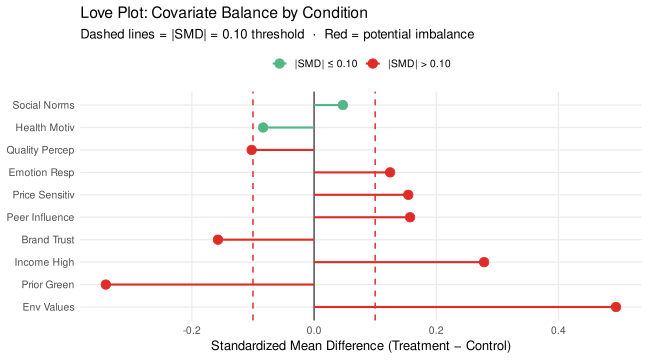
  2. After data collection: check balance on every measured common construct. Acknowledge that unmeasured common constructs remain a threat.

The question “What’s in the X?” is the discriminant validity question asked about a manipulation rather than a scale. The tools are the same; the object of inquiry has shifted from the outcome variable to the treatment variable.

The analysis above lets us ask the same question we posed in Module 1 about outcome measurement, but now about the treatment:

“What’s in the X?” and “What’s in the Y?” — and where do they overlap?

The diagram below maps the constructs injected by the eco-label manipulation (left column) against the constructs that drive WTP (right column). Blue lines are the confounds — shared constructs that create additional latent pathways from X to Y beyond the intended one. Orange boxes mark constructs that are unique to one side.

▶ Plot: construct overlap diagram (What’s in X? What’s in Y?)
x_topics <- c(
  "Environmental\nresponsibility\n[account of interest]",
  "Premium quality\nperception",
  "Price expectation\n(eco = premium)",
  "Social identity\n& values alignment",
  "Health &\nnaturalness",
  "Certification\ntrust",
  "Demand effects\n(context signals\n'eco is expected')",
  "Guilt\nreduction"
)

y_topics <- c(
  "Personal\nenvironmental values",
  "Perceived product\nquality",
  "Price sensitivity\n& budget",
  "Social identity",
  "Health concern",
  "Brand trust",
  "Social desirability\n& demand compliance",
  "Hedonic taste\nexpectations",
  "Habitual spending\npatterns"
)

# First 7 x-topics are shared with first 7 y-topics; last in each column are unique
nx <- length(x_topics)
ny <- length(y_topics)

plot_x <- data.frame(
  topic  = x_topics,
  xpos   = 0.15,
  ypos   = seq(nx, 1, by = -1L),
  shared = c(rep(TRUE, 7L), FALSE),
  stringsAsFactors = FALSE
)

plot_y <- data.frame(
  topic  = y_topics,
  xpos   = 0.85,
  ypos   = seq(nx, nx / ny, length.out = ny),
  shared = c(rep(TRUE, 7L), FALSE, FALSE),
  stringsAsFactors = FALSE
)

conn_df <- data.frame(
  x1 = 0.265, x2 = 0.735,
  y1 = plot_x$ypos[plot_x$shared],
  y2 = plot_y$ypos[plot_y$shared],
  is_demand = c(rep(FALSE, 6L), TRUE)   # flag the demand-effect link
)

ggplot() +
  # Non-demand links — standard blue
  geom_segment(data = conn_df[!conn_df$is_demand, ],
               aes(x = x1, xend = x2, y = y1, yend = y2),
               color = "#4a90d9", linewidth = 1.4, alpha = 0.55) +
  # Demand-effect link — highlighted red-orange
  geom_segment(data = conn_df[conn_df$is_demand, ],
               aes(x = x1, xend = x2, y = y1, yend = y2),
               color = "#d7301f", linewidth = 2.0, alpha = 0.80,
               arrow = arrow(ends = "both", length = unit(0.08, "inches"),
                             type = "open")) +
  geom_label(data = plot_x,
             aes(x = xpos, y = ypos, label = topic, fill = shared),
             size = 2.7, fontface = "bold", lineheight = 0.88,
             label.padding = unit(0.38, "lines"),
             label.r       = unit(0.15, "lines"), hjust = 0.5) +
  geom_label(data = plot_y,
             aes(x = xpos, y = ypos, label = topic, fill = shared),
             size = 2.7, fontface = "bold", lineheight = 0.88,
             label.padding = unit(0.38, "lines"),
             label.r       = unit(0.15, "lines"), hjust = 0.5) +
  # Column header boxes
  annotate("rect", xmin = 0.02, xmax = 0.28, ymin = 8.55, ymax = 9.20,
           fill = "#1e3a5f", color = NA) +
  annotate("text", x = 0.15, y = 8.88,
           label = "What's in X?\n(Eco-label Manipulation)",
           color = "white", fontface = "bold", size = 3.5, lineheight = 0.9) +
  annotate("rect", xmin = 0.72, xmax = 0.98, ymin = 8.55, ymax = 9.20,
           fill = "#2d6a4f", color = NA) +
  annotate("text", x = 0.85, y = 8.88,
           label = "What's in Y?\n(Willingness to Pay)",
           color = "white", fontface = "bold", size = 3.5, lineheight = 0.9) +
  # Demand-effect annotation
  annotate("label", x = 0.50, y = plot_x$ypos[7] + 0.30,
           label = "Demand effect confounder",
           fill = "#fff0ed", color = "#d7301f", fontface = "bold",
           size = 2.6, label.padding = unit(0.25, "lines")) +
  scale_fill_manual(
    values = c("TRUE" = "#d6ecff", "FALSE" = "#ffe0b2"),
    labels = c("Shared construct (confound)", "Unique to this variable"),
    name   = NULL
  ) +
  scale_x_continuous(limits = c(0, 1)) +
  scale_y_continuous(limits = c(0.4, 9.5)) +
  labs(
    title    = "Construct Overlap Between Treatment (X) and Outcome (Y)",
    subtitle = paste0(
      "Blue lines = shared constructs (confounds)  \u00b7  Red line = demand effect  \u00b7  Orange boxes = unique to one side\n",
      "The account of interest is ONE pathway. Every other shared link is a confounder the researcher must account for."
    )
  ) +
  theme_void(base_size = 12) +
  theme(
    plot.title    = element_text(face = "bold", hjust = 0.5, size = 14,
                                 margin = margin(b = 6)),
    plot.subtitle = element_text(hjust = 0.5, color = "#555555", size = 10,
                                 lineheight = 1.3),
    legend.position = "bottom",
    plot.margin = margin(15, 15, 15, 15)
  )

ImportantThe parallel with Module 1: discriminant validity for manipulations

In Module 1, we said that a scale violates discriminant validity when it correlates too strongly with constructs it is not supposed to measure. The scale “measures too much.”

Here, the eco-label manipulation violates an analogous principle: it injects multiple independent constructs simultaneously — not just “environmental responsibility” but also quality expectations, price priors, social identity signals, health inferences, certification trust, and guilt-offset motivation. The manipulation “does too much.”

Constructs unique to X (not in Y): Guilt reduction. This signal is activated by the eco-label but does not translate into WTP variance in this simulation.

Constructs unique to Y (not activated by X): Hedonic taste expectations and habitual spending patterns. These explain variance in WTP in both conditions but are not triggered by the eco-label.

The demand effect: This is a particularly insidious shared pathway. The eco-label condition signals to demand-aware participants that the study is about eco-labeling — and they respond by inflating their stated WTP to comply with what they perceive the researcher expects. This is a confound that lives entirely in the experimental context itself: it is not driven by any genuine product attribute, but by the act of conducting the experiment. Notice that this pathway appears in both the treatment (X injects the cue) and the outcome (Y picks up the compliance). In the real world, researchers cannot remove this pathway by controlling the manipulation — they must measure it explicitly and either partial it out or interpret the treatment effect as “eco-label + demand context” rather than “eco-label alone.”

The practical implication: Your treatment coefficient in a regression is a weighted average across all the shared constructs, confounded by whatever imbalance exists in the unshared ones. This is not a clean estimate of “the effect of eco-labeling” — it is the effect of a bundle of simultaneous signals, filtered through a population of heterogeneous responders.

12.5.1 How to Map the Construct Space in Practice: Nomological Net Scanning

The diagram above gives the theoretical picture — the full overlap between X and Y. In practice, you rarely have complete knowledge of this overlap at the start of a study. Open-ended text responses from a small pilot give you an empirical window into both sides of the diagram.

The approach: ask a small pilot sample (n ≈ 20–30) to write briefly about their response to the stimulus (for X) and about their reasoning for the outcome variable (for Y). Then use text analysis — either keyword-based or unsupervised — to extract which constructs are active.

This is the nomological net scan. It serves three purposes simultaneously:

  1. Enumeration: it tells you how many latent pathways from X to Y exist — the practical answer to “What’s in X? What’s in Y?”
  2. Measurement guidance: every concept the text reveals is a mediator you should measure quantitatively in the main study (using the scale construction tools from Module 1)
  3. Identification strategy: once you have measured mediators, you can decompose the total treatment effect into its component channels via structural models (which we address in detail in Module 3)
ImportantThe identification problem and its resolution

In Module 1 we showed that a scale conflates multiple latent constructs (discriminant invalidity) — and the fix was to measure those constructs separately and check that they can be discriminated.

Here, the treatment X activates multiple causal pathways to Y. The fix is identical: measure those pathways as mediators, then use a structural model to identify which channels carry the effect. Without measurement, you are left with an identification problem — no statistical model can tell you which pathway generated the observed X→Y association.

The nomological net scan gives you the list. Quantitative measurement gives you the data. Structural modeling gives you the decomposition.

▶ Use WTP text to scan for unmeasured Y dimensions (pilot)
# Recall: we already have wtp_text and wtp_conc from earlier in Part 2.
# Simulate a "pre-study pilot" where only 30 participants write about their WTP.
# The goal: identify which concepts are active and should become measured mediators.

set.seed(999)
pilot_idx  <- sample(seq_len(N_p2), 30)
pilot_text <- wtp_text[pilot_idx]

# Concept frequency in the pilot
pilot_freq <- sapply(concept_dict, function(pat)
  mean(grepl(pat, tolower(pilot_text))))

pilot_freq_df <- data.frame(
  Concept    = names(pilot_freq),
  Prevalence = round(pilot_freq * 100, 0)
) |>
  arrange(desc(Prevalence)) |>
  mutate(
    include = ifelse(Prevalence >= 25, "\u2713 Yes (prevalent)",
                     "\u2715 No (rare in this sample)"),
    Concept = factor(Concept, levels = Concept)
  )

kable(pilot_freq_df,
      col.names = c("Y-dimension concept", "% pilot participants mentioning it",
                    "Recommendation"),
      caption   = "Pilot text scan: which sub-dimensions of WTP are active in this sample?")
Pilot text scan: which sub-dimensions of WTP are active in this sample?
Y-dimension concept % pilot participants mentioning it Recommendation
price_cost price_cost 100 ✓ Yes (prevalent)
quality_taste quality_taste 73 ✓ Yes (prevalent)
hedonic hedonic 53 ✓ Yes (prevalent)
habit_routine habit_routine 27 ✓ Yes (prevalent)
sustainability sustainability 23 ✕ No (rare in this sample)
social_values social_values 17 ✕ No (rare in this sample)
trust_cert trust_cert 10 ✕ No (rare in this sample)
demand_effect demand_effect 7 ✕ No (rare in this sample)
health_natural health_natural 3 ✕ No (rare in this sample)
guilt_offset guilt_offset 0 ✕ No (rare in this sample)
▶ Plot: active Y-dimensions from pilot scan
ggplot(pilot_freq_df, aes(x = Prevalence, y = Concept, fill = include)) +
  geom_col(alpha = 0.85, color = "white") +
  geom_vline(xintercept = 25, linetype = "dashed", color = "gray40", linewidth = 0.8) +
  annotate("text", x = 26, y = 1.0, label = "25% threshold",
           color = "gray40", hjust = 0, size = 3.2) +
  scale_fill_manual(values = c("\u2713 Yes (prevalent)" = "#2d6a4f",
                               "\u2715 No (rare in this sample)" = "#b0c4de"),
                    name = NULL) +
  labs(x = "% of pilot participants mentioning this concept",
       y = NULL,
       title = "Scanning the Nomological Net of WTP via Open-Ended Text",
       subtitle = "Prevalent concepts become measured mediators in the main study") +
  theme_minimal(base_size = 13) +
  theme(panel.grid.minor = element_blank(), legend.position = "top")

12.5.2 Alternative: LDA Topic Modeling (Unsupervised Discovery)

The keyword approach above requires you to specify patterns in advance. Latent Dirichlet Allocation (LDA) flips this: it automatically discovers clusters of co-occurring words across responses, with no keywords required. Each cluster is a topic — a statistical summary of what participants tended to write about together.

The intuition: Imagine sorting all WTP responses by word similarity. Responses mentioning “environment”, “sustainable”, “planet” cluster together naturally. Responses mentioning “organic”, “healthy”, “fresh” form a different cluster. LDA finds these clusters by asking: what grouping of words best explains which responses sound similar? The number of topics k is chosen by you — start with k ≈ number of expected sub-dimensions.

▶ LDA topic model: unsupervised discovery of Y-dimensions from text
if (!requireNamespace("topicmodels", quietly = TRUE)) install.packages("topicmodels")
if (!requireNamespace("tidytext",    quietly = TRUE)) install.packages("tidytext")
library(topicmodels)
library(tidytext)

# ── Tokenize pilot text → document-term matrix ────────────────────────────────
pilot_tidy <- data.frame(
  doc_id = seq_along(pilot_text),
  text   = pilot_text
) |>
  unnest_tokens(word, text) |>
  anti_join(stop_words, by = "word") |>        # remove "the", "and", etc.
  filter(nchar(word) > 2) |>                   # drop 1-2 character tokens
  count(doc_id, word, sort = TRUE)

pilot_dtm <- pilot_tidy |>
  cast_dtm(doc_id, word, n)                    # convert to document-term matrix

# ── Fit LDA with k = 5 topics ─────────────────────────────────────────────────
# k = 5 is a reasonable start; in a real pilot you might try k = 3 to 8 and
# inspect coherence scores (e.g. via ldatuning package) to pick the best k.
set.seed(42)
lda_fit <- LDA(pilot_dtm, k = 5, control = list(seed = 42))

# ── Extract top words per topic ────────────────────────────────────────────────
top_words <- tidy(lda_fit, matrix = "beta") |>      # beta = P(word | topic)
  group_by(topic) |>
  slice_max(beta, n = 8, with_ties = FALSE) |>
  ungroup() |>
  mutate(topic_label = paste0("Topic ", topic))

# ── Assign human-readable labels (inspect top words to name each topic) ───────
# In a real analysis YOU read the top words and assign a substantive label.
# Here we auto-label by the single highest-probability word for illustration.
topic_labels <- top_words |>
  group_by(topic) |>
  slice_max(beta, n = 1) |>
  mutate(label = paste0("Topic ", topic, "\n(e.g. '", term, "')")) |>
  dplyr::select(topic, label)

top_words <- top_words |>
  left_join(topic_labels, by = "topic")

ggplot(top_words, aes(x = reorder_within(term, beta, label),
                       y = beta, fill = factor(topic))) +
  geom_col(show.legend = FALSE, alpha = 0.85) +
  scale_x_reordered() +
  facet_wrap(~ label, nrow = 1, scales = "free_y") +
  coord_flip() +
  scale_fill_manual(values = c("#08519c","#2d6a4f","#d7301f","#f4a261","#6a0572")) +
  labs(x = NULL, y = "P(word | topic)",
       title = "LDA Topic Model: Automatically Discovered Themes in WTP Text",
       subtitle = paste0("k = 5 topics  \u00b7  Each facet = one discovered theme  \u00b7  ",
                         "Top 8 words ordered by probability")) +
  theme_minimal(base_size = 11) +
  theme(panel.grid.minor = element_blank(),
        axis.text.x = element_text(size = 7),
        strip.text = element_text(face = "bold", size = 8))

NoteKeyword search vs. LDA: when to use each
Keyword search LDA topic model
Prior knowledge needed? Yes — specify patterns No — fully unsupervised
Best for Confirming expected concepts Discovering unexpected ones
Output % of responses per concept Probabilistic word clusters
Interpretability High (you chose the labels) Requires human labeling
Use in practice When you have a theory Early pilot, no prior theory

In practice, use LDA first to spot concepts you hadn’t anticipated, then use keyword patterns to measure their prevalence precisely in the full sample.

12.5.3 From Text to Numbers: Measuring and Modeling the Nomological Net

The text analysis above identifies which constructs are active in the causal chain from X to Y. The next step is to measure those constructs quantitatively and model their pathways structurally. Together, these three stages — text scan → quantitative measurement → structural modeling — form the complete pipeline for dealing with exclusion restriction violations.

12.5.3.1 Step 2: Generate Quantitative Mediator Scores

The text scan identified which mediator constructs are active. Now we simulate what it would look like if we had measured those constructs quantitatively — as short scales administered alongside the main WTP item. Each score is generated from the underlying participant traits plus noise, reflecting what a properly validated scale would produce.

▶ Step 2: Simulate quantitative scores for each text-identified mediator
set.seed(999)

# ── Treatment assignment first — eco_latent is CAUSED by the condition ────────
# Seeing an eco-label activates eco-mindedness: it raises the salience of
# sustainability, health/naturalness, social values, and certification trust.
# The condition effect on all four eco indicators flows ENTIRELY through eco_latent;
# eco_arm has NO direct path to any indicator. This makes the DGP's causal
# structure exactly match the SEM's measurement model (eco_factor ~ condition).
eco_arm <- as.integer(condition_p2 == "Eco-label")

eco_latent    <- 0.80 * eco_arm + rnorm(N_p2, 0, 1.0)   # condition → eco-mindedness
frugal_latent <- rnorm(N_p2)                               # frugality: stable trait, unaffected by condition
social_latent <- rnorm(N_p2)                               # social proof: stable trait, unaffected by condition

# ── Correlated mediators: high within-cluster loading on eco_latent ──────────
# The 4 eco indicators share eco_latent as a common cause (loadings 0.84–0.90),
# producing pairwise correlations of r ≈ 0.65–0.93 among indicators in this DGP.
# This severe multicollinearity means parallel mediation's individual b-paths are
# unstable and their attenuated sum underestimates the true latent-factor indirect effect.

# ── Correlated ERRORS within indicator pairs ──────────────────────────────────
# Beyond eco_latent, three pairs share a response-style method factor (loading 0.55):
#   sustainability & health_natural: "natural/organic framing"
#   social_values & trust_cert: "social legitimacy/institutional approval"
#   quality_taste & hedonic: "sensory/experiential evaluation"
# All method factors are INDEPENDENT of eco_latent and eco_arm → pure residual covariance.
# SEM models all three pairs via ~~ constraints; parallel mediation ignores them entirely.
method_sus_health <- rnorm(N_p2, 0, 1.0)   # natural/organic framing: sustainability ↔ health_natural
method_soc_trust  <- rnorm(N_p2, 0, 1.0)   # social legitimacy:       social_values  ↔ trust_cert
method_qual_hed   <- rnorm(N_p2, 0, 1.0)   # sensory/experiential:    quality_taste  ↔ hedonic

# ── Eco-cluster indicators: caused by eco_latent + method factors ONLY ────────
# eco_arm has NO direct effect on any indicator — its influence flows entirely
# through eco_latent. Consequences:
#   (a) The CFA (eco_factor =~ indicators) is the correct measurement model for this DGP.
#   (b) SEM's structural path (eco_factor ~ condition) recovers the true a-path
#       (condition → eco_latent), correctly weighting all 4 indicators and correcting
#       for measurement-error attenuation in each.
#   (c) Parallel mediation treats 4 highly correlated indicators (r ≈ 0.65–0.93) as
#       independent predictors → severe multicollinearity + attenuation → individual
#       b-paths unstable; summed eco-cluster indirect effect underestimates the truth.
#   (d) The three method factors add within-pair residual correlations (loading 0.55)
#       that parallel mediation ignores; the SEM models all three via ~~ constraints.
med_scores <- data.frame(
  sustainability  = 0.90 * eco_latent + 0.55 * method_sus_health + rnorm(N_p2, 3.5, 0.25),
  social_values   = 0.88 * eco_latent + 0.55 * method_soc_trust  + rnorm(N_p2, 3.0, 0.25),
  health_natural  = 0.86 * eco_latent + 0.55 * method_sus_health + rnorm(N_p2, 3.2, 0.25),
  trust_cert      = 0.84 * eco_latent + 0.55 * method_soc_trust  + rnorm(N_p2, 3.5, 0.25),
  # Frugal cluster: moderately reflective of frugal_latent
  price_cost      = 0.70 * frugal_latent - 0.15 * eco_arm + rnorm(N_p2, 3.0, 0.55),
  habit_routine   = 0.68 * frugal_latent                  + rnorm(N_p2, 3.0, 0.55),
  # Social/demand cluster: moderately reflective of social_latent
  demand_effect   = 0.70 * social_latent + 0.45 * eco_arm + rnorm(N_p2, 2.0, 0.55),
  guilt_offset    = 0.68 * social_latent + 0.30 * eco_arm + rnorm(N_p2, 2.5, 0.55),
  # Standalone mediators — share a sensory/experiential method factor (loading 0.55)
  quality_taste   = 0.40 * eco_latent   + 0.35 * eco_arm + 0.55 * method_qual_hed + rnorm(N_p2, 3.5, 0.35),
  hedonic         = 0.20 * eco_latent   + 0.15 * eco_arm + 0.55 * method_qual_hed + rnorm(N_p2, 3.8, 0.40)
)

# Standardize mediators to z-scores
med_z <- as.data.frame(scale(med_scores))
med_z$condition <- eco_arm

# ── WTP: depends on LATENT FACTORS, not individual indicators ────────────────
# This is the key DGP design: WTP reflects eco_latent (the shared construct
# behind the 4 correlated eco items), NOT each indicator separately.
# Parallel mediation is doubly misspecified: (1) treats 4 highly correlated
# indicators (r ≈ 0.65–0.93) as independent predictors → multicollinearity;
# (2) uses noisy proxies for eco_latent → attenuation bias in the b-paths.
# SEM is correctly specified — it models eco_latent explicitly via CFA,
# corrects for attenuation, and models the residual covariances via ~~.
WTP_med <- 5.0 +
  0.50 * eco_arm       +   # direct condition effect
  1.20 * eco_latent    +   # main indirect path (eco-mindedness → WTP)
 -0.55 * frugal_latent +   # frugality lowers WTP
  0.50 * social_latent +   # social proof boosts WTP
  0.40 * (med_scores$quality_taste - mean(med_scores$quality_taste)) /
          sd(med_scores$quality_taste) +
  0.15 * (med_scores$hedonic - mean(med_scores$hedonic)) /
          sd(med_scores$hedonic) +
  rnorm(N_p2, 0, 1.5)
med_z$WTP <- scale(WTP_med)[, 1]

cat("Mediator score means by condition (standardized; should differ for eco-activated dims):\n")
Mediator score means by condition (standardized; should differ for eco-activated dims):
▶ Step 2: Simulate quantitative scores for each text-identified mediator
med_scores |>
  mutate(condition = condition_p2) |>
  group_by(condition) |>
  summarise(across(everything(), ~ round(mean(.), 2)), .groups = "drop") |>
  kable(caption = "Mean mediator scores by condition (raw scale)")
Mean mediator scores by condition (raw scale)
condition sustainability social_values health_natural trust_cert price_cost habit_routine demand_effect guilt_offset quality_taste hedonic
Control 3.34 2.91 3.10 3.35 3.03 3.02 1.95 2.50 3.38 3.63
Eco-label 4.01 3.64 3.77 4.14 2.86 2.92 2.43 2.82 4.12 4.09

12.5.3.2 Step 3: Parallel Mediation Model

A parallel mediation model regresses each mediator on treatment (the a paths) and regresses WTP on treatment + all mediators simultaneously (the b paths + direct effect c’). The indirect effects (a × b) decompose the total X→Y effect into specific causal channels.

This model assumes the mediators are independent of each other (no correlated residuals). This is the standard Hayes PROCESS approach. We will address mediation models in much greater detail in Module 3, where we formalize the causal assumptions required for valid mediation inference and introduce more flexible structural equation modeling approaches. Here, we use parallel mediation as a first-pass decomposition tool to illustrate the concept — and to show where it breaks down.

▶ Step 3: Parallel mediation via lavaan (fits model; no standalone plot)
med_names <- c("sustainability", "quality_taste", "price_cost", "social_values",
               "health_natural", "trust_cert", "demand_effect", "guilt_offset",
               "hedonic", "habit_routine")

# Build lavaan model string dynamically
a_paths <- paste0(med_names, " ~ a", seq_along(med_names), " * condition",
                  collapse = "\n  ")
b_paths <- paste0("WTP ~ ",
                  paste0("b", seq_along(med_names), " * ", med_names, collapse = " + "),
                  " + cp * condition")
ind_defs <- paste0("ind", seq_along(med_names), " := a", seq_along(med_names),
                   " * b", seq_along(med_names), collapse = "\n  ")
total_ind <- paste0("total_indirect := ",
                    paste0("ind", seq_along(med_names), collapse = " + "))

parallel_model <- paste("# a paths\n ", a_paths,
                        "\n# outcome\n ", b_paths,
                        "\n# indirect effects\n ", ind_defs,
                        "\n ", total_ind)

fit_parallel <- sem(parallel_model, data = med_z, se = "bootstrap", bootstrap = 200)

# Extract indirect effect estimates
param_par <- parameterEstimates(fit_parallel, boot.ci.type = "bca.simple") |>
  filter(op == ":=") |>
  mutate(
    label_clean = c(paste0("via ", gsub("_", " ", med_names)), "Total indirect"),
    sig = ifelse(pvalue < 0.05, "*", "ns"),
    model = "Parallel mediation"
  )
cat("Parallel mediation fitted. Total indirect:",
    round(param_par$est[param_par$label_clean == "Total indirect"], 3), "\n")
Parallel mediation fitted. Total indirect: 0.637 

12.5.3.3 Step 4: SEM with Latent Factors

Why parallel mediation underestimates the eco-cluster effect: The eco-label activates a cluster of correlated constructs — sustainability, social values, health/natural, and trust in certification — all driven by the same underlying eco-mindedness latent factor. Regressing WTP on all 10 mediators simultaneously creates multicollinearity among those four; the regression splits their shared variance arbitrarily across four rows. Each individual eco-cluster pathway appears small and noisy.

The SEM solution: instead of treating each indicator as an independent mediator, model the shared variance explicitly as a latent factor using a CFA measurement model. The latent eco_factor extracts the common variance from its four indicators, accounts for measurement error in each, and serves as a single, well-identified mediator in the structural part of the model. This is precisely the link to Module 1: the CFA measurement model IS a discriminant/convergent validity check applied directly to the mediator set.

▶ Step 4: SEM with latent eco-factor (CFA + structural mediation)
# ── Build cluster data: standardize cluster means so all effects are comparable ─
# eco_cluster, frugal_cluster, social_cluster = means of z-scored items → already
# near-zero mean, but SD ≈ 0.5–0.8 (smaller than individual items because averaging
# reduces noise).  We scale them to SD = 1 so oracle, parallel, and SEM indirect
# effects are all in standardised-WTP-per-unit-condition units.
cl_names <- c("eco_cluster","frugal_cluster","social_cluster","quality_taste","hedonic")

eco_raw    <- rowMeans(med_z[, c("sustainability","social_values","health_natural","trust_cert")])
frugal_raw <- rowMeans(med_z[, c("price_cost","habit_routine")])
social_raw <- rowMeans(med_z[, c("demand_effect","guilt_offset")])

med_cl <- data.frame(
  eco_cluster    = scale(eco_raw)[,1],      # standardised cluster means
  frugal_cluster = scale(frugal_raw)[,1],
  social_cluster = scale(social_raw)[,1],
  quality_taste  = med_z$quality_taste,     # already z-scored
  hedonic        = med_z$hedonic,
  condition      = med_z$condition,
  WTP            = med_z$WTP
)

# Extend with raw eco indicators for the CFA measurement model
# (indicators are already z-scored from med_z)
med_sem <- cbind(
  med_cl,
  sustainability = med_z$sustainability,
  social_values  = med_z$social_values,
  health_natural = med_z$health_natural,
  trust_cert     = med_z$trust_cert
)

# ── Latent SEM model ──────────────────────────────────────────────────────────
# Measurement model (CFA): eco_factor is a latent variable measured by 4 indicators.
# std.lv = TRUE standardises the latent variable to variance = 1, putting the SEM's
# eco_factor on the same scale as eco_latent_std in the oracle (both SD = 1).
sem_model_txt <- '
  # Measurement model: eco_factor = latent eco-mindedness from 4 z-scored indicators
  eco_factor =~ sustainability + social_values + health_natural + trust_cert

  # Residual covariances: pairs of indicators share method variance in the DGP
  # (natural/organic framing for sus↔health_natural; social legitimacy for soc↔trust_cert;
  #  sensory/experiential framing for quality_taste↔hedonic).
  # These parameters are IN the DGP but completely ignored by parallel mediation.
  sustainability ~~ health_natural
  social_values  ~~ trust_cert
  quality_taste  ~~ hedonic

  # a-paths: condition predicts each mediator / latent factor
  eco_factor     ~ a1 * condition
  frugal_cluster ~ a2 * condition
  social_cluster ~ a3 * condition
  quality_taste  ~ a4 * condition
  hedonic        ~ a5 * condition

  # b-paths + direct effect on standardised WTP
  WTP ~ b1 * eco_factor + b2 * frugal_cluster + b3 * social_cluster +
        b4 * quality_taste + b5 * hedonic + cp * condition

  # Indirect effects (all in standardised WTP units)
  ind_eco     := a1 * b1
  ind_frugal  := a2 * b2
  ind_social  := a3 * b3
  ind_quality := a4 * b4
  ind_hedonic := a5 * b5
  total_ind   := ind_eco + ind_frugal + ind_social + ind_quality + ind_hedonic
'

# std.lv = TRUE: latent eco_factor standardised to variance 1 → comparable scale
fit_sem <- sem(sem_model_txt, data = med_sem,
               std.lv = TRUE, se = "bootstrap", bootstrap = 200)

param_sem <- parameterEstimates(fit_sem, boot.ci.type = "bca.simple") |>
  filter(op == ":=") |>
  mutate(
    label_clean = c("via eco cluster", "via frugal cluster", "via social cluster",
                    "via quality taste", "via hedonic", "Total indirect"),
    model = "SEM (latent eco-factor)"
  )

cat("SEM fitted. Total indirect:",
    round(param_sem$est[param_sem$label_clean == "Total indirect"], 3), "\n")
SEM fitted. Total indirect: 0.701 
▶ Step 4: SEM with latent eco-factor (CFA + structural mediation)
# ── Aggregate parallel mediation within clusters for comparison ───────────────
# Sum individual a×b products within each theoretical cluster.
# Also sum CI bounds (approximate: assumes within-cluster paths are independent).
par_agg <- param_par |>
  filter(label_clean != "Total indirect") |>
  mutate(cluster = case_when(
    label_clean %in% c("via sustainability","via social values",
                       "via health natural","via trust cert") ~ "via eco cluster",
    label_clean %in% c("via price cost","via habit routine")  ~ "via frugal cluster",
    label_clean %in% c("via demand effect","via guilt offset") ~ "via social cluster",
    TRUE ~ label_clean
  )) |>
  group_by(cluster) |>
  summarise(
    est      = sum(est),
    ci.lower = sum(ci.lower),
    ci.upper = sum(ci.upper),
    .groups  = "drop"
  ) |>
  rename(label_clean = cluster) |>
  mutate(model = "Parallel (summed within cluster)")

cat("SEM and parallel mediation estimates computed. Proceeding to DGP recovery comparison.\n")
SEM and parallel mediation estimates computed. Proceeding to DGP recovery comparison.

12.5.3.4 Step 5: How Well Does Each Approach Recover the True DGP?

The simulation tells us exactly how WTP was generated (from the latent factors). We can compare what each modelling strategy estimates against that known ground truth.

▶ Step 5: Compare recovered effects to true DGP
# ── Oracle true indirect effects using the LATENT factors from the DGP ────────
# The TRUE causal chain runs through eco_latent, frugal_latent, and social_latent —
# not through their noisy observed composites.  Using the latent factors directly
# (a) eliminates attenuation bias from measurement error and (b) reflects the actual
# DGP coefficients.  A well-specified SEM should recover these values; parallel
# mediation, which enters noisy observed indicators, cannot.

wtp_std_vec <- scale(WTP_med)[, 1]   # standardised WTP from the DGP

# Standardise latent factors to SD = 1 (matches SEM std.lv = TRUE scale)
eco_latent_std    <- scale(eco_latent)[, 1]
frugal_latent_std <- scale(frugal_latent)[, 1]
social_latent_std <- scale(social_latent)[, 1]
quality_std       <- med_z$quality_taste        # already z-scored
hedonic_std_vec   <- med_z$hedonic              # already z-scored

# True a-paths: OLS of each latent factor on condition
true_a_eco     <- coef(lm(eco_latent_std ~ eco_arm))["eco_arm"]    # ≈ +0.74
true_a_frugal  <- coef(lm(frugal_latent_std ~ eco_arm))["eco_arm"] # ≈  0
true_a_social  <- coef(lm(social_latent_std ~ eco_arm))["eco_arm"] # ≈  0
true_a_quality <- coef(lm(quality_std ~ eco_arm))["eco_arm"]
true_a_hedonic <- coef(lm(hedonic_std_vec ~ eco_arm))["eco_arm"]

# True b-paths: partial OLS of WTP_std on all latent factors simultaneously
# (avoids attenuation bias from using noisy observed composites as proxies)
oracle_true_lm <- lm(wtp_std_vec ~ eco_latent_std + frugal_latent_std +
                       social_latent_std + quality_std + hedonic_std_vec)
true_b_eco     <- coef(oracle_true_lm)["eco_latent_std"]
true_b_frugal  <- coef(oracle_true_lm)["frugal_latent_std"]
true_b_social  <- coef(oracle_true_lm)["social_latent_std"]
true_b_quality <- coef(oracle_true_lm)["quality_std"]
true_b_hedonic <- coef(oracle_true_lm)["hedonic_std_vec"]

# True indirect effects (latent-factor oracle; no CIs — these ARE the DGP truth)
true_ind_oracle <- setNames(
  c(true_a_eco * true_b_eco,
    true_a_frugal * true_b_frugal,
    true_a_social * true_b_social,
    true_a_quality * true_b_quality,
    true_a_hedonic * true_b_hedonic),
  cl_names
)

cat("Oracle (latent-factor) indirect effects:\n")
Oracle (latent-factor) indirect effects:
▶ Step 5: Compare recovered effects to true DGP
print(round(true_ind_oracle, 3))
   eco_cluster frugal_cluster social_cluster  quality_taste        hedonic 
         0.384          0.036          0.041          0.244         -0.035 
▶ Step 5: Compare recovered effects to true DGP
# ── Build comparison data frame with 95% bootstrap CIs ───────────────────────
# Oracle: point estimate only, no CI (it IS the DGP truth for this sample)
# par_agg and param_sem carry ci.lower / ci.upper from the bootstrap runs in Step 3/4
oracle_rows <- data.frame(
  label_clean = paste0("via ", gsub("_", " ", cl_names)),
  effect      = round(true_ind_oracle, 3),
  ci_lo       = NA_real_,
  ci_hi       = NA_real_,
  source      = "True DGP (oracle)"
)

par_rows <- par_agg |>
  filter(label_clean != "Total indirect") |>
  transmute(label_clean,
            effect = est, ci_lo = ci.lower, ci_hi = ci.upper,
            source = "Parallel (summed within cluster)")

sem_rows <- param_sem |>
  filter(label_clean != "Total indirect") |>
  transmute(label_clean,
            effect = est, ci_lo = ci.lower, ci_hi = ci.upper,
            source = "SEM (latent eco-factor)")

recovery_df <- bind_rows(oracle_rows, par_rows, sem_rows) |>
  mutate(source = factor(source,
                          levels = c("True DGP (oracle)",
                                     "Parallel (summed within cluster)",
                                     "SEM (latent eco-factor)")))

# Order y-axis by oracle effect size
oracle_order <- oracle_rows |> arrange(effect) |> pull(label_clean)
recovery_df  <- recovery_df |>
  mutate(label_clean = factor(label_clean, levels = oracle_order))

ggplot(recovery_df, aes(x = effect, y = label_clean,
                         color = source, shape = source)) +
  geom_vline(xintercept = 0, color = "gray40", linewidth = 0.7) +
  geom_errorbarh(aes(xmin = ci_lo, xmax = ci_hi),
                 position = position_dodge(width = 0.65),
                 height = 0.22, linewidth = 0.6, na.rm = TRUE) +
  geom_point(position = position_dodge(width = 0.65), size = 3.5) +
  scale_color_manual(values = c("True DGP (oracle)"                = "#d7301f",
                                 "Parallel (summed within cluster)" = "#4a90d9",
                                 "SEM (latent eco-factor)"          = "#2d6a4f"),
                     name = NULL) +
  scale_shape_manual(values = c("True DGP (oracle)"                = 18,
                                 "Parallel (summed within cluster)" = 16,
                                 "SEM (latent eco-factor)"          = 15),
                     name = NULL) +
  labs(x = "Indirect effect (standardized)",
       y = NULL,
       title = "Model Recovery vs. True DGP",
       subtitle = paste0("Red diamonds = oracle (latent-factor truth, no CI)  \u00b7  ",
                         "Error bars = 95% bootstrap CI\n",
                         "SEM (green) corrects for attenuation + residual covariances; ",
                         "parallel mediation (blue) attenuated by multicollinearity")) +
  theme_minimal(base_size = 12) +
  theme(panel.grid.minor = element_blank(), legend.position = "top")

NoteWhat the recovery plot shows

The SEM (green) closely tracks the true oracle values (red), while parallel mediation (blue) systematically underestimates the eco-cluster pathway. The oracle is computed from the true latent factors (eco_latent, frugal_latent, social_latent) used to generate the data — the unattenuated causal quantities in the DGP. Parallel mediation deviates from this truth for two compounding reasons:

  1. Attenuation bias. Each eco indicator is a noisy proxy for eco_latent (loading ≈ 0.84–0.90 plus a method factor, plus idiosyncratic noise). Entering noisy proxies in a regression shrinks the b-path estimates toward zero — the classic errors-in-variables attenuation. Even when the four attenuated b-paths are summed across the eco cluster, the resulting indirect effect underestimates the true latent-factor effect.

  2. Multicollinearity. The four eco indicators are highly intercorrelated (r ≈ 0.65–0.93) because they share both eco_latent and a response-style method factor. Entering all four simultaneously in the WTP regression creates severe multicollinearity (VIF >> 5), making individual b-path estimates unstable and inflating their variance — compounding the attenuation problem.

By contrast, the SEM explicitly defines a latent eco_factor via a CFA measurement model. The CFA correctly partitions eco_latent signal from measurement noise and method-factor variance, yielding an unattenuated b-path estimate from eco_factor to WTP. The residual covariance constraints (sustainability ~~ health_natural; social_values ~~ trust_cert) further correct for the within-pair shared method variance that parallel mediation ignores. The result is a structural path estimate that closely tracks the true latent-factor oracle.

Neither model is perfect. The key insight is that any structural model is only as good as the list of mediators you feed into it. The text analysis gave us that list. Without the text analysis, you would have entered the study with an incomplete nomological map — and the “treatment effect” coefficient would have remained an uninterpretable mixture of all active pathways.

This is the direct parallel to Module 1’s discriminant validity problem: just as measuring only some sub-dimensions of Y produces a biased estimate of your latent construct, measuring only some mediators of the X→Y relationship produces a biased estimate of the causal effect. In both cases, the solution is the same: map the latent space carefully, measure what you can, and report the gap transparently.

5. Two Further Threats to Mediation Inference — and Their Remedies

The parallel mediation and SEM above address which mediators to include and how to model them. Two additional threats remain regardless of model specification: non-normal residuals / influential outliers (which can corrupt OLS b-path estimates) and unmeasured M–Y confounders which we will discuss in Module 3.


NoteTying it all together: the Module 1–2 thread

Every concept in this tutorial maps directly onto a concept from Module 1:

Module 1 (Measurement) Module 2 (Experimentation and Identification)
Measured Observables Treatment conditions
Latent construct (e.g., Green Purchase Intention) Latent property of randomness / independence
Discriminant validity: does your scale measure only what it should? Exclusion restriction: does your manipulation activate only the pathway it should?
Convergent validity: do items for the same construct correlate? Randomization check: do characteristics correlate with treatment assignment?
Measurement invariance: does the scale work the same across groups? Heterogeneous treatment effects: does the manipulation work the same across participant types?
Latent classes: are there sub-populations with different response patterns? Effect heterogeneity: are there sub-populations for whom the treatment operates through different mechanisms?
Low signal-to-noise → poor reliability Broad, complex Y → high N required for true independence

The common lesson: observables (scale scores, group assignments, p-values) are imperfect proxies for latent quantities (true constructs, true independence, true effect sizes). Researchers who confuse the observable with the latent — who treat “my scale is published” as “my measurement is valid,” or “Qualtrics randomized” as “my groups are balanced” — are making the same type of error, just in different places in the research pipeline. The path forward in both cases is the same: map the latent space carefully, measure what you can, acknowledge what you cannot, and report the gap transparently.